 RoomTour
Selling your house privately: the hard part isn't the paperwork
You can sell your home without an estate agent anywhere in the UK. A conveyancer handles the legal side whether or not there's an agent. What an agent really sells you is marketing and viewings, and that's where private sellers struggle:
- Looking credible. Buyers compare your listing with agency listings that have 20 photos, a floor plan and a virtual tour. A handful of phone snaps makes a private sale look like a risk.
- Viewings that go nowhere. Without an agent, every viewing is your evening or your Saturday. Plenty of people turn up to a house they'd have ruled out if they'd seen the layout first.
- Buyers who can't come. Someone relocating from another city, a family buying for an elderly parent, or a buyer abroad won't travel to see a house that might not suit them.
The saving is real. The HomeOwners Alliance puts the average fee at 1.42% including VAT in 2026, roughly £3,900 on a £275,000 home. To keep that saving, you need to present the house as well as an agent would.
How RoomTour works when you're selling your own home
- Get the house ready. Lights on, blinds up, worktops clear. The same as for listing photos.
- Take about 30 guided shots per room. Stand in the middle of each room and turn with your iPhone; the app shows one target on screen at a time. No tripod, 360 camera or LiDAR needed.
- The app stitches each room into a 360° panorama on the phone and, from the phone's motion tracking, sketches an approximate floor plan.
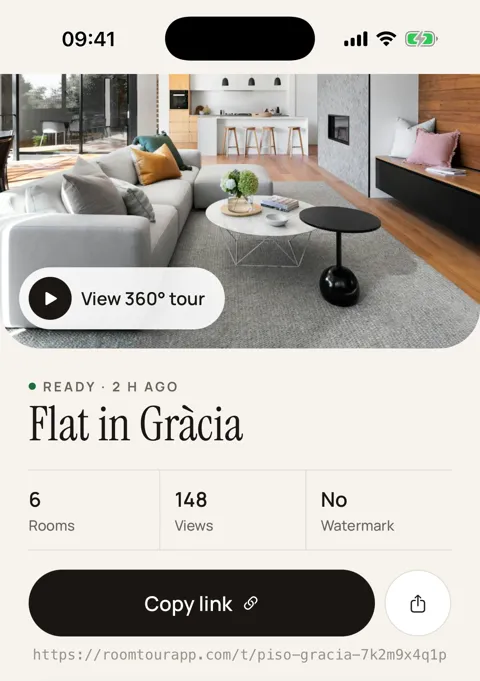
- Publish the tour and you get a link (roomtourapp.com/t/…), an embed code for a website and an A4 QR poster.
- Share it in your listing description, in every reply to an enquiry and on the "For Sale" poster in your window.
Want to see the result first? Open the example tour on your phone.
What you get
- A tour link that opens on any phone or computer without an app. It's the answer to the first "is this still available?".
- An embeddable iframe, if you're selling through your own website or a page about the house.
- An A4 QR poster. Private sellers can't use an agent's board, but a poster in the front window works: people walking past scan it and look round inside before they ring you. The poster is in English with
?lang=enon its link, and there's a language toggle on the poster page. - An approximate floor plan showing how the rooms connect. It can drift 10 to 20 cm, so it's for orientation, not measuring, and it doesn't replace the floor area on your EPC.
- View counts. The app tells you how many times the tour has been opened. Lots of listing views and few tour views usually means the photos or the price need work.
Fewer viewings, better viewings
A tour doesn't replace a viewing; almost nobody buys a home without walking through it. What changes is who comes. Someone who asks to view after going round the kitchen, the bathroom and the bedrooms on their phone already knows the layout works for them. Fewer "just having a look" viewings, more serious buyers.
For buyers who aren't local, the tour is often the first viewing. They can show it to a partner or family and travel only when it makes sense.
One practical line for your listing: "Before you book a viewing, walk round the house in 360°: [link]". Pair it with the templates in how to write a property listing and you'll answer most of the repeat questions before they're asked.
What RoomTour doesn't do (and when something else is better)
- It doesn't get you onto Rightmove or Zoopla. There's no portal integration. For the big portals you'll need an agent or a fixed-fee online agent; the tour link goes in the description where the platform allows it, and in your messages.
- It doesn't measure. The floor plan is approximate. For exact dimensions, use a surveyor or a measured plan.
- It isn't a 3D "dollhouse" model. For that, you need a Matterport-style scanner or a photographer who has one.
- iPhone only. There's no Android version.
- It doesn't replace a conveyancer. Private sales still need one, and the steps are in how to sell your house privately in the UK.
If you decide an agent is worth the fee, that's a reasonable call: they take the work off you. What doesn't make sense is selling privately and showing the house worse than an agent would.
In the US: for sale by owner
Selling without a realtor works the same way. You can list FSBO on Zillow, and a tour link answers the first round of questions from buyers who'd otherwise drive over for nothing. Closing rules vary by state, so speak to a real estate attorney or title company.
Free for early users
RoomTour is free for early users: making and sharing tours costs nothing and there's no watermark. The iPhone app is now on the App Store.
Frequently asked questions
Can I sell my house privately in the UK?
Yes. There's no legal requirement to use an estate agent. You still need an EPC before you market the home (a Home Report in Scotland) and a solicitor or licensed conveyancer for the legal transfer. The full process is in how to sell your house privately in the UK.
Can I list my house on Rightmove without an estate agent?
No. Rightmove told Property Industry Eye that 'all sellers must go through an estate agent' to advertise on it. Private sellers usually reach the big portals through a fixed-fee online agent.
How much do you save selling a house without an estate agent?
The HomeOwners Alliance puts the average UK fee at 1.42% including VAT in 2026, about £3,900 on a £275,000 sale. Selling yourself saves that, but you take on the marketing and the viewings.
Is it easy to sell a house without an estate agent?
The paperwork is handled largely by your conveyancer. The hard part is getting buyers to see the house and filtering out people who were never going to buy. Good photos, a clear listing and a virtual tour do a lot of that work.
How do I sell my house without a realtor in the US?
It's called for sale by owner (FSBO). You can list on Zillow as an owner, though those listings don't appear on the MLS. You'll still want a real estate attorney or title company for the closing, and state rules differ.